Homes for rent in Budaörs
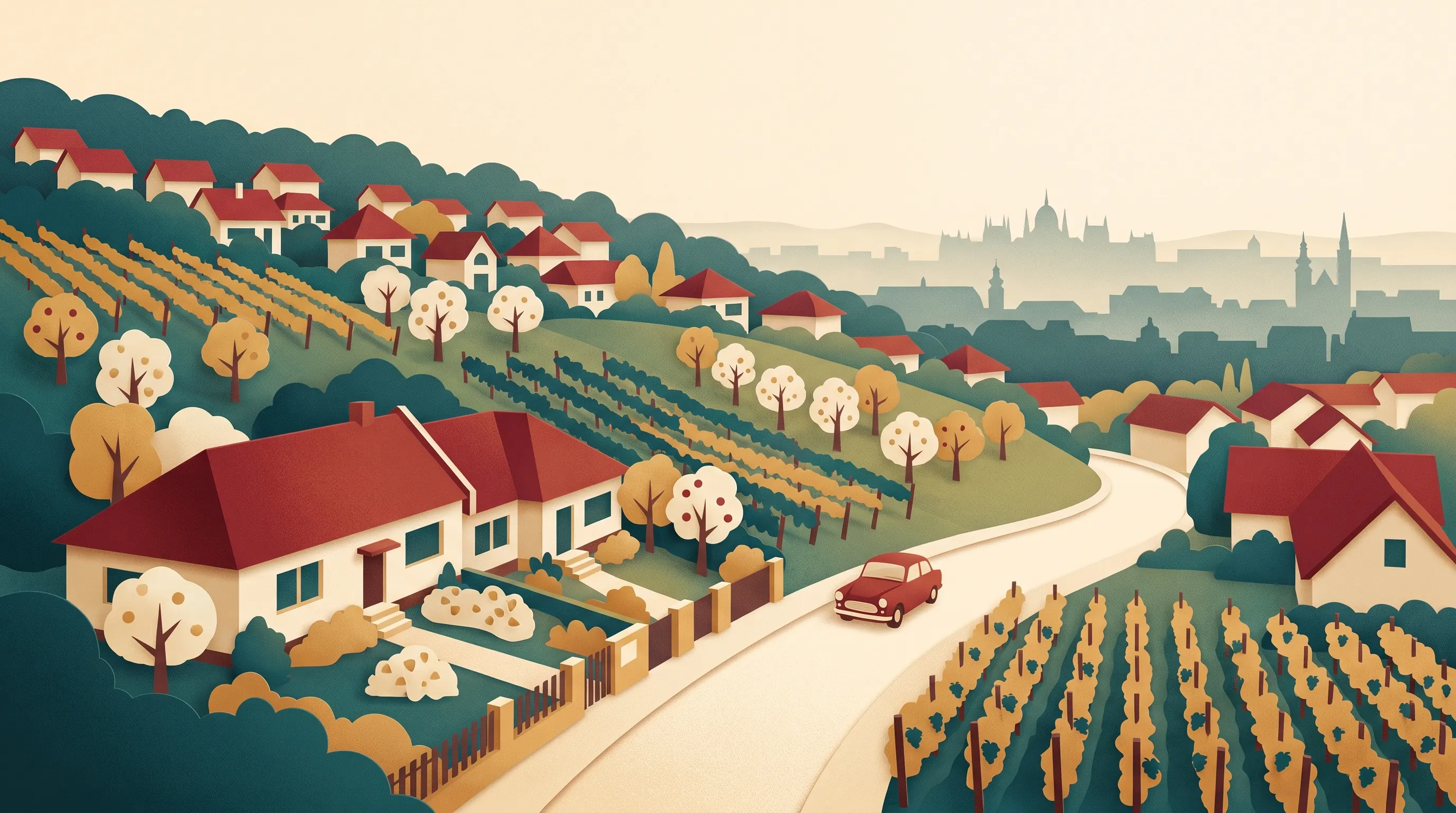
Budaörs: the first town past the Buda hills, with the M1 and M7 on its doorstep.
Budaörs sits just west of districts XI and XII, at the junction of the M1 and M7 motorways. It is the most established of the western suburbs, with family houses on the hillside, a big retail zone along the motorway, and a bus into Kelenföld in twenty minutes. Rents are below the inner Buda districts, and houses with gardens are the norm.
Nothing listed in Budaörs yet
We launched in September 2026 and are adding landlords now. Have a flat to rent out here? It takes a few minutes and it is free.
A renter's guide to Budaörs
Budaörs is the suburb that behaves most like a town in its own right. It has a Swabian old centre around Templom tér and Szabadság út, a town hall, a market, its own schools and secondary schools, a large sports park with an indoor pool, and a hospital-scale health centre. Up the slopes of the Csiki hills and the Kő-hegy are the streets of houses that most renters come for; along the M1/M7 below them is one of the biggest retail zones in the country, with IKEA, Auchan, Decathlon and everything else in a row.
The town sits directly against districts XI and XII, so parts of Budaörs are closer to Kelenföld than parts of Buda are. Traffic is the cost of that position: the M1/M7 approach into Budapest slows every morning, and Budaörs itself fills with through-traffic. The compensation is that you are on the motorway to Vienna, Balaton and the airport ring road within minutes.
Daily life needs a car for most families, but less than in the other western towns; the bus corridor to Kelenföld is frequent, and the centre and the retail zone are walkable or a short cycle from much of the town.
Typical rent in Budaörs
| from | to | |
|---|---|---|
| 1 room | HUF 160,000 | HUF 230,000 |
| 2 rooms | HUF 230,000 | HUF 330,000 |
| 3 rooms | HUF 320,000 | HUF 550,000 |
Typical asking rents per month for a whole home on a long-term let, September 2026. Ranges, not quotes: a renovated flat with a lift sits at the top, a ground-floor courtyard flat at the bottom.
Getting around
- Volánbusz and BKK buses along Szabadság út to Kelenföld (M4): 15 to 25 minutes depending on where you board and the traffic; from Kelenföld the M4 reaches Deák in 12 minutes, so 35 to 45 minutes door to door.
- Budaörs has a railway station on the Tatabánya/Győr line at the southern edge of the town, with S10 trains to Kelenföld in about 10 minutes and Déli in 20; it is a bus or bike ride from the residential streets.
- Bus 40, 40E and 240 from Móricz Zsigmond körtér and Kelenföld serve the town; night bus 940 runs after midnight.
- By car: Kelenföld in 10 to 15 minutes, the centre in 25 to 45 minutes; the M1, M7 and M0 all begin at the town boundary.
What the homes are like
The market is houses first: detached and semi-detached family houses on the hillsides from the 1970s to today, many split into two flats with a shared garden; 1990s and 2000s villas on the upper streets with views and a garage; and terraced new builds in the Frankhegy and Kamaraerdő edges. A three-room listing is normally a whole house or the larger half of one, and prices climb with the slope and the view.
Flats are fewer than in Budapest but real: the older three-storey blocks of the Ifjúság utca and Patkó utca estate near the centre with 2-room, 55 square metre plans and district heating, and newer condominiums around the centre and near the retail zone with gas boilers, lifts and underground parking. Check heating type and winter road access on the hillside, and ask about noise from the motorway on the southern streets.
Who it suits
Budaörs suits families who want a house and a garden without giving up a real town centre and schools, international families near the XII district schools, and anyone commuting to Kelenföld, the M0 office parks or the airport by car. It suits couples who want a newer flat at prices below inner Buda. It suits less well someone who needs to be in the city centre daily without a car; it is possible, but slower than living on the M4.
Parts of Budaörs
- Old centre
- Templom tér, Szabadság út and the streets around them: the Swabian town core, shops, the market, schools and the older estate. Flattest, most walkable, best bus access.
- Hillside
- The streets climbing the Kő-hegy and the Csiki hills above the centre: family houses, villas and views over the town. The classic Budaörs address, car needed.
- Kamaraerdő edge
- The eastern side toward district XI and the Kamaraerdő woods, with newer terraced houses and quick access to Kelenföld. Closest to Budapest.
- Frankhegy and the western streets
- The newer residential streets toward Törökbálint and the airport road, with recent houses and more space. Furthest from the centre.
Questions people ask about Budaörs
Is Budaörs a good place to live for expats and families?
It is one of the most popular suburbs for exactly that reason: a real town with schools, a pool, a hospital-scale clinic, big-box shopping and the Buda hills behind it, ten minutes from the international schools of district XII. Rents for houses are below inner Buda. The daily cost is the motorway commute.
How long is the commute from Budaörs to central Budapest?
Bus to Kelenföld in 15 to 25 minutes and the M4 to Deák in 12 more, so about 40 minutes door to door. The train from Budaörs station takes 10 minutes to Kelenföld but the station is at the edge of town. By car the centre is 30 to 45 minutes in the morning.
How much does it cost to rent a house in Budaörs?
A three-room family house with a garden typically asks 320 000 to 550 000 forints a month; hillside villas with views and a garage go above that. Halves of split houses and two-room flats sit between 230 000 and 330 000.
Do I need a car in Budaörs?
Most households have one, and on the hillside it is close to essential. In the old centre and near the bus corridor you can manage with buses and a bicycle, since the shops, schools and Kelenföld are all reachable. If you work along the M0 or at the airport, the car is the point of living here.