Flats for rent in XXI. Csepel
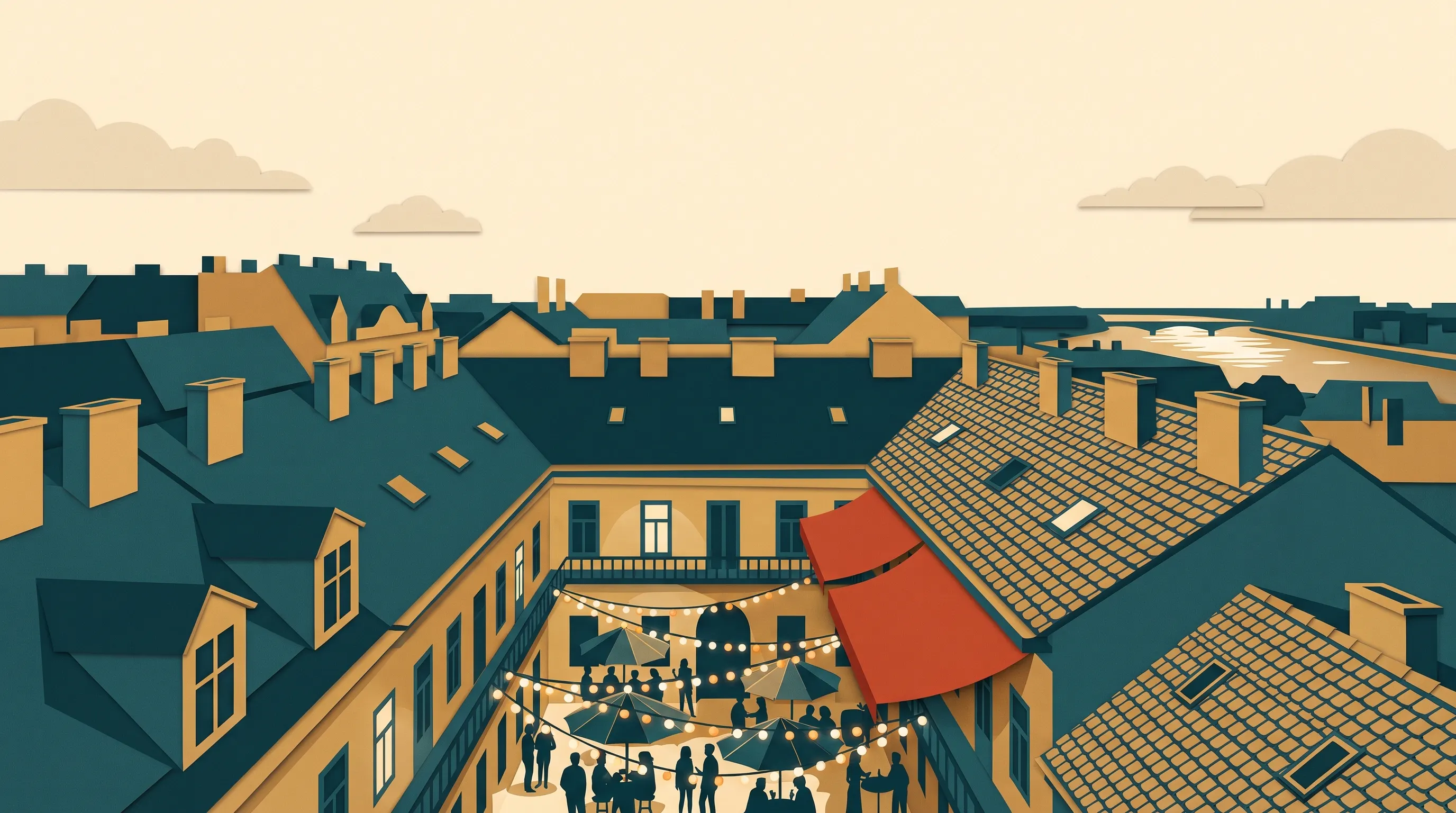
Csepel: an island district with a town of its own.
District XXI covers the northern part of Csepel Island. It grew around a large ironworks and has its own centre, parks and river banks. The HÉV suburban train runs to Boráros tér. Rents are low and flats tend to be in panel and post-war blocks.
Nothing listed in XXI. Csepel yet
We launched in September 2026 and are adding landlords now. Have a flat to rent out here? It takes a few minutes and it is free.
A renter's guide to XXI. Csepel
Csepel is the only district on an island, and that shapes everything: two bridges to Pest (Kvassay and Gubacsi), one to Buda (the M0 Deák Ferenc bridge at the southern edge), and a HÉV line that is the daily lifeline. The town grew around the Csepel Works, whose enormous walled site still occupies the north-east of the district, and the centre at Szent Imre tér has the town hall, the church, the market and the HÉV terminus within a few hundred metres of each other.
Housing is more varied than the panel reputation suggests. The estates are real, Csillagtelep in the south and the blocks around Kossuth Lajos utca, but the west and south of the district are streets of family houses in Csepel-Kertváros and Királyerdő, and the old village core of Ófalu sits by the Danube. The Kis-Duna on the eastern side has the Csepel bath on Hollandi út and long, green banks.
Rents are among the lowest in Budapest, partly because of the bridges: when the Kvassay bridge or Soroksári út is jammed, the island waits. Locals plan around the HÉV instead. Daily shopping is easy, with the Csepel Plaza, a large market and supermarkets around the centre.
Typical rent in XXI. Csepel
| from | to | |
|---|---|---|
| 1 room | HUF 140,000 | HUF 190,000 |
| 2 rooms | HUF 180,000 | HUF 245,000 |
| 3 rooms | HUF 230,000 | HUF 320,000 |
Typical asking rents per month for a whole home on a long-term let, September 2026. Ranges, not quotes: a renovated flat with a lift sits at the top, a ground-floor courtyard flat at the bottom.
Getting around
- HÉV H7 from Csepel (Szent Imre tér) to Boráros tér in 12 to 14 minutes, every 5 to 10 minutes in the day; from Boráros tér, tram 4 and 6 or tram 2 take you on, so Deák is 30 to 35 minutes door to door.
- Buses cross the Kvassay bridge to Boráros tér and Soroksári út, and the Gubacsi bridge to Pesterzsébet and the Határ út metro.
- Within the island, buses fan out from Szent Imre tér to Csillagtelep, Királyerdő and Kertváros; the far south is a 15 to 20 minute bus ride from the HÉV.
- By car the M0 at the southern end links to the M1, M7 and M5 without going through the city; the centre is 30 to 45 minutes in traffic.
- Night bus 936 keeps the island connected after the HÉV stops.
What the homes are like
The estates offer 1+1 and 2-room panel flats of 45 to 60 square metres, district heated, many with insulated façades since the 2010s. Csillagtelep also has lower, more spacious brick blocks from the 1950s with 2 and 3 rooms and gas heating, which are often the better deal. Around the centre there are 1960s brick blocks and a few small newer condominiums with gas boilers and parking.
Királyerdő and Kertváros are the house market: 1960s to 1980s family houses on 500 to 800 square metre plots, some split into two flats, some new terraced houses on the edges. Rented houses here go for what a large two-room flat costs in inner Pest. Check the heating (gas boiler versus older convectors), the insulation, and how far the nearest bus stop is, because distances inside the island are larger than they look.
Who it suits
Csepel suits people who work on the island or in south Pest, families who want a house on a budget, and anyone happy to organise life around the HÉV. It is a good fit for people with a car who need the M0 more than the city centre. It is a bad fit if you have to be in the centre late and often; the bridges and the HÉV timetable set the rhythm.
Parts of XXI. Csepel
- Csepel centre
- Szent Imre tér and Kossuth Lajos utca: the HÉV terminus, the town hall, the market, the plaza and the older blocks. The best connected part of the island.
- Csillagtelep
- The large estate in the south around Kossuth Lajos utca and Szent László út, a mix of panel and 1950s brick blocks with shops, schools and a lot of green space between the buildings. Cheap and self-contained.
- Királyerdő
- Family houses and gardens in the south-east, running down to the Kis-Duna and the Hollandi út bath. Quiet, leafy, car or bus needed for the HÉV.
- Csepel-Kertváros and Ófalu
- Houses on the western side toward the main Danube and the old village core by the river. Residential, with the Csepel Works boundary to the north.
Questions people ask about XXI. Csepel
Is Csepel a good place to live?
For the money, yes. It is a working town with its own centre, schools, a bath, a plaza and a lot of river bank, and rents are about 40 percent below the city average. What you give up is quick access to the centre; the HÉV is reliable but you will be on it every day.
How long is the commute from Csepel to the centre?
HÉV H7 takes 12 to 14 minutes to Boráros tér, then tram 4 or 6 to the Grand Boulevard or tram 2 along the Danube. Plan 30 to 35 minutes to Deák from the centre of Csepel and 45 to 50 from Csillagtelep. By car in the morning peak the Kvassay bridge alone can take 20 minutes.
Are there family houses to rent in Csepel?
Yes, mostly in Királyerdő and Kertváros. Whole houses with gardens and split two-storey houses come up regularly at rents that in Buda would buy a small flat. The south of the island is a bus ride from the HÉV, so factor that in.
Does Csepel flood?
The inhabited parts are behind flood defences and the estates are well inland; the Kis-Duna bank has holiday-house zones that can be affected in high water. If you are renting right by the water, ask the owner about 2013, when the Danube was at its highest in living memory.